Riparian planting on your farm
Riparian planting is a great way to help filter nutrient run off and create biodiversity habitat on your farm. We spoke to Horizons Regional Council (HRC) Freshwater Advisor, Sarah Falloon, to find out more about what it entails.
Why riparian planting?
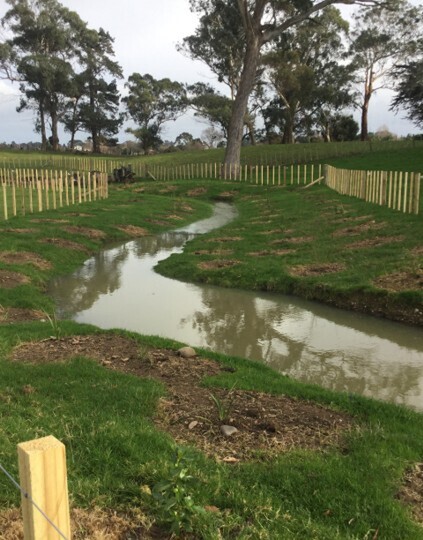
Riparian planting involves planting any kind of trees within the margins of a waterway to help filter nutrient run off and create biodiversity habitat, Sarah explains.
“Most people equate it to just being native plants, but it doesn’t have to be. An introduced tree, like an oak, will work just as well as a native.”
HRC funding does only cover native plants, but Sarah understands they can be expensive and harder to establish, so it comes down to landowner preference when selecting trees.
“All trees are good. The main thing we want to do is create shade over the waterway, shade cover is the most important thing when it comes to habitat and filtration, as it decreases the temperature of the water.”
Shade will not only create habitat for the likes of lizards and birds, the leafy matter that falls in the water provides food for many invertebrates, and so it goes on in one big life cycle.
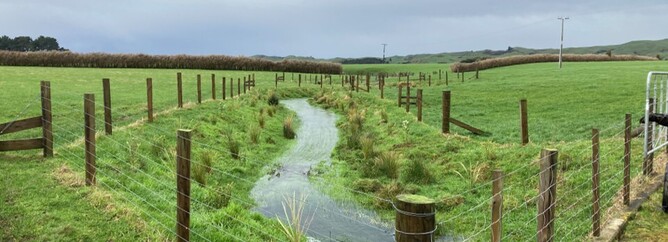
Once fenced and planted, stock exclusion is the number one priority to give trees the best chance of survival, and for filtration, she says.
What is considered riparian planting?
Anything that is a flowing form of water – this includes waterways that flow all year round and those that do not.
Seeps or bogs, which are considered to be ‘biodiversity hotspots’, are also included.
A stand-alone dam for stock water, where the water does not go anywhere, is not included.
What sort of funding is available for riparian planting?
HRC will provide funding for native planting, 50% of the plant’s cost. There are some criteria that must be met in order to qualify for funding:
- Full stock exclusion
- It must be a waterway (seeps and bogs included)
- A site visit must be completed by HRC prior to starting
- Natives must be planted within 20 metres of the waterway
There is also funding available for fencing, up to 40% depending on the project. “This can be anything from two-wire up to deer fencing, but it is a capped rate and we do need to see the site beforehand.”
For those farmers who have a Sustainable Land Use Initiative (SLUI) plan, there may be other funding opportunities available, so check with your advisor before starting.
The site visit is mandatory and Sarah is here to help. She can provide advice on possible sites on your property, as well as plant selection to ensure species that are suitable for your area e.g. coastal. She takes care of all the plant ordering and delivery, and can even organise contractors to plant the natives, though she says most farmers prefer to plant their own.
“We don’t want a monoculture, and I can recommend site specific species that will do well.”
Sarah can also provide advice and resources on site preparation, spot spraying prior to planting and release spraying after, as well as pest control. All of this is key to good plant establishment. For more top tips on native plant establishment see this article on our website.
To qualify for funding, the correct process must be followed. If you are interested in finding out more, please contact Sarah Falloon: Sarah.Falloon@horizons.govt.nz or call 0212277263. Alternatively, contact your SLUI advisor.